Wildflowers, Seamless Floral Patterns: Timeless Elegance Meets Modern Digital Craft
There’s something quietly powerful about wildflowers—not just in nature, but in design. Their asymmetry, soft color transitions, and organic irregularity carry an authenticity that feels both nostalgic and refreshingly current. When translated into seamless floral patterns, they become more than decoration: they’re versatile visual tools for creators who value intentionality, texture, and timeless appeal. This is where Wildflowers, Seamless Floral Patterns meets the practical reality of digital creation—offering high-resolution, repeat-ready JPEGs designed not just to look beautiful, but to work flawlessly across real-world applications.
What Makes a Seamless Floral Pattern Truly Seamless?
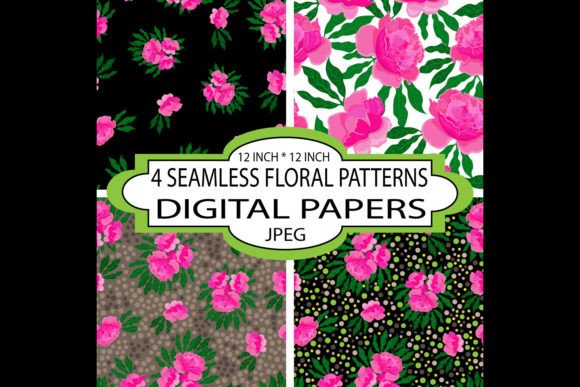
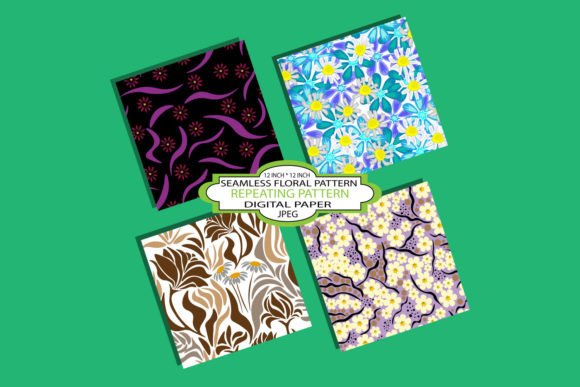
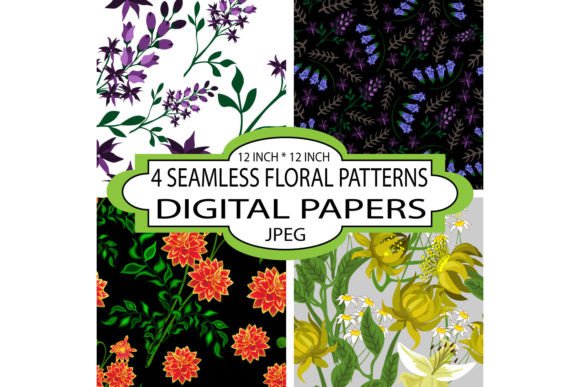
A seamless pattern isn’t just a pretty image tiled across a screen—it’s engineered precision. Each edge must align perfectly so that no visible seam, stripe, or mismatch appears when repeated horizontally or vertically. That means no abrupt cutoffs at the border, no duplicated stems or petals, and no unintended gaps or overlaps. These 4 JPEG files—each 3600px × 3600px (12″ × 12″ at 300 DPI)—are built with that exact standard in mind. They’re tested for repetition integrity, ensuring clean continuity whether scaled down for greeting cards or enlarged for wallpaper murals.
This level of technical care matters because it removes friction from creative workflows. Designers don’t need to spend hours masking edges or adjusting tile offsets. Print-on-demand sellers can upload directly to platforms like Spoonflower or Printful without reworking resolution or alignment. Educators preparing classroom materials, small-business owners designing branded stationery, or crafters assembling custom gift wrap—all benefit from reliability baked into the file itself.
Retro Elegance, Reimagined for Today’s Tools
The “retro elegance” aesthetic—think muted botanical palettes, hand-drawn linework, and gentle watercolor washes—is experiencing a thoughtful resurgence. It’s not about replicating 1950s motifs wholesale, but rather borrowing their restraint, warmth, and human touch. These Wildflowers, Seamless Floral Patterns honor that sensibility: soft sage greens, dusty mauves, parchment neutrals, and faded coral tones sit alongside delicate outlines and subtle textural layering—evoking vintage botanical prints while remaining digitally crisp and adaptable.
Unlike mass-produced clipart or AI-generated florals that often feel generic or overly symmetrical, these patterns retain a quiet individuality. A single stem may curve slightly more to the left; a cluster of Queen Anne’s lace might drift off-center—just enough to echo how wildflowers actually grow. That nuance supports emotional resonance: stationery feels personal, fabric feels artisanal, and branding feels grounded rather than algorithmic.
Why Digital Paper Is More Than a Convenience
Digital paper—high-res, printable, seamless pattern files—has evolved from a niche resource into a foundational asset for independent makers. It’s not simply about saving on physical swatch books or shipping costs. It’s about agility: testing a new bedding line in three colorways before committing to yardage; prototyping wedding invitations with five different floral motifs in under an hour; or updating a Shopify store’s packaging design between product drops.
These Wildflowers, Seamless Floral Patterns are optimized for that flexibility. At 3600px square and 300 DPI, they scale cleanly from business card size (2.5″ × 3.5″) up to wall murals (10+ feet wide). Because they’re JPEGs—not layered PSDs or vector-based EPS—they load quickly, open universally, and integrate smoothly into Canva, Adobe Express, Affinity Designer, Cricut Design Space, and even basic photo editors. No plugins, no compatibility headaches—just immediate usability.
Real-World Applications, Not Just Possibilities
When creators ask, “Can I really use this across so many formats?”, the answer lies in consistent, field-tested application:
- Textiles & Home Goods: One designer used a lavender-and-cream wildflower pattern to develop a limited-run pillowcase collection—printing through a local fabric printer with zero tiling artifacts, even across 22″ × 22″ panels.
- Stationery & Card Making: A small greeting card brand layered the same pattern beneath hand-lettered quotes, then exported as print-ready PDFs—no visible repeat lines at trim edges, even after die-cutting.
- Scrapbooking & Digital Journals: Users report clean scaling inside GoodNotes and Notability, with no pixelation when zooming into journal headers or page dividers.
- Interior Design Mockups: Architects and interior stylists embedded the patterns into 3D room renders (using SketchUp + V-Ray), where repeat integrity held up under lighting simulations and perspective distortion.
- Gift Wrap & Packaging: A boutique chocolatier printed the pattern onto kraft paper via a desktop inkjet—adjusting saturation slightly for matte stock, but never needing to alter the base file.
That cross-platform resilience comes from deliberate design choices: balanced motif density (not too sparse, not overcrowded), intentional negative space for breathing room, and color values calibrated for both screen and CMYK print fidelity.
Shifting Creative Expectations—and What That Means for You
Today’s audiences respond less to “perfect” and more to “considered.” A social media post showing behind-the-scenes sketchbook pages next to a finished pillow cover builds trust faster than a polished ad alone. Consumers increasingly recognize—and value—the difference between mass-produced visuals and thoughtfully curated ones. That shift rewards creators who invest in assets with character, consistency, and technical polish.
For freelancers, having a reliable library of Wildflowers, Seamless Floral Patterns means faster client revisions and stronger portfolio cohesion. For educators, it means creating visually rich handouts without licensing concerns or copyright ambiguity. For entrepreneurs launching a lifestyle brand, it means establishing a distinctive visual language early—without outsourcing every background or pattern.
This isn’t about chasing trends. It’s about aligning your toolkit with how people now discover, evaluate, and connect with creative work: visually literate, context-aware, and sensitive to authenticity—even in something as seemingly simple as a repeating floral motif.
Getting Started—Without Overcomplicating It
You don’t need specialized software or advanced design training to begin using these patterns effectively. Start small:
- Open one JPEG in any image editor—even Preview (Mac) or Photos (Windows)—and crop a 6″ × 6″ section to test on a greeting card mockup.
- Upload to a free platform like Canva, place it as a background, and adjust transparency to 85% for subtle texture beneath text.
- Print a single 8.5″ × 11″ sheet on matte cardstock and fold it into a mini notebook cover—notice how the pattern flows across the spine without interruption.
- If working with fabric, check your printer’s maximum width and tile the pattern manually in a layout app (like Affinity Publisher) to confirm seam alignment before ordering yardage.
Each step reinforces how well-designed digital paper reduces guesswork—and expands what’s possible within familiar tools.
Thoughtful Design, Built to Last
Wildflowers, Seamless Floral Patterns reflect a broader movement: away from disposable visuals and toward assets with longevity. They’re not meant to trend for six weeks and fade. They’re built to complement evolving projects—whether you’re designing a wedding suite this spring, launching a ceramic studio brand next fall, or updating your online course materials in two years’ time. The retro elegance isn’t costume—it’s continuity. The seamlessness isn’t convenience—it’s confidence in execution.
In a landscape crowded with shortcuts and synthetic aesthetics, choosing patterns rooted in natural rhythm, refined technique, and practical resolution is a quiet act of creative intention. It signals care—for your process, your audience, and the tangible things you bring into the world.