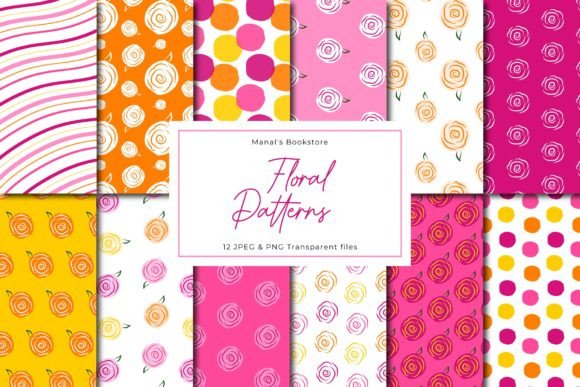
12 Floral Patterns: A Versatile Creative Foundation for Designers, Educators, and Makers
Floral motifs have endured across centuries—not as fleeting trends, but as deeply resonant visual language. Their organic rhythm, symbolic richness, and structural versatility make them foundational in both traditional craft and contemporary digital design. The 12 Floral Patterns paper pack exemplifies this timelessness while meeting modern creative demands: it delivers twelve distinct, high-fidelity botanical compositions—each thoughtfully scaled, balanced, and technically optimized—not as static decorations, but as adaptable raw material.
Why Resolution and Format Flexibility Matter in Practice
At first glance, the technical specs may seem like background detail: 3600×3600 pixels, JPG and PNG transparency variants, 12 unique designs. Yet these specifications directly shape real-world usability. A 3600×3600 pixel resolution ensures crisp output whether printing a 24×24-inch wall art piece or scaling down a motif for a 2-inch sticker. Unlike lower-resolution assets that blur or pixelate under enlargement, these files retain clarity even when cropped tightly or layered with typography.
The dual-format delivery—JPG for fast web use and print-ready color fidelity, PNG with transparent backgrounds for non-rectangular applications—is not merely convenient; it eliminates common workflow bottlenecks. For example, a small-batch apparel designer can drag a transparent floral pattern directly into vector software, overlay it on a T-shirt mockup, and adjust opacity or blend mode without manually removing white backgrounds. Similarly, an educator creating printable classroom posters can place a floral border around learning objectives without worrying about mismatched background colors.
Diverse Applications Across Professional and Personal Contexts
The breadth of recommended uses—art projects, prints, T-shirts, posters, bags, scrapbooking, cardmaking, planners, stickers, postcards, invitations, fabrics, greeting cards, home decorations, wall art, quotes, blogs, websites, banners—is not aspirational listing. It reflects how the 12 Floral Patterns set functions as modular visual infrastructure rather than decorative add-ons.
- Small Business Owners: A local bakery launching seasonal packaging can apply one of the patterns to kraft paper gift tags (via PNG transparency), then reuse the same motif as a subtle watermark on digital order confirmations—creating cohesive brand texture without custom illustration costs.
- Educators: Teachers designing differentiated reading trackers can embed a soft floral frame around progress charts using the JPG version, while students in a digital arts elective layer transparent florals over photography projects to explore composition and depth—all without licensing concerns or attribution overhead.
- Hobbyists & Scrapbookers: Unlike tiled seamless patterns that repeat predictably, each of the 12 Floral Patterns is a singular, hand-crafted arrangement—ideal for focal-point layouts where repetition would undermine visual interest. A vintage-style travel journal might feature Pattern #7 (a climbing ivy-and-rose composition) as a full-page background behind handwritten entries, while Pattern #2 (a tight cluster of peonies and eucalyptus) becomes a die-cut embellishment.
- Web Designers & Bloggers: These files integrate seamlessly into CMS platforms. A wellness blogger can set Pattern #9—a delicate sprig-based motif—as a subtle background for callout boxes in WordPress, adjusting CSS opacity to ensure text legibility. No plugin required; no external CDN dependency.
Design Integrity Meets Technical Precision
What distinguishes this collection from generic floral clipart is its attention to compositional hierarchy and negative space. Each of the 12 Floral Patterns balances density and breath: petals overlap with intentional variation in scale and orientation, stems curve with natural asymmetry, and foliage provides grounding without visual clutter. This isn’t algorithmically generated filler—it’s curated visual grammar.
Consider Pattern #4: a radial arrangement centered on a camellia, surrounded by trailing jasmine and fern fronds. Its symmetry invites use in mandala-inspired planners or fabric repeats, yet its slight irregularities (a petal turned slightly inward, a stem bending at an unexpected angle) prevent mechanical rigidity. That nuance matters when translating to physical media—fabric printing, for instance, benefits from organic flow that avoids the “too-perfect” look associated with low-effort digital assets.
Similarly, Pattern #11—a minimalist line-drawn wisteria cascade—demonstrates how restraint expands utility. Its thin strokes render cleanly at small sizes (ideal for planner icons or email newsletter dividers), while its vertical rhythm lends itself to repeating as a border on invitation suites. The inclusion of such stylistic range across the 12 Floral Patterns means users aren’t forced to stretch one aesthetic across incompatible contexts.
Workflow Integration Without Compromise
Many designers avoid pre-made pattern packs due to compatibility friction: mismatched color profiles, inconsistent DPI, or embedded watermarks. The 12 Floral Patterns set sidesteps these pitfalls through deliberate standardization. All files adhere to sRGB color space—ensuring predictable rendering across monitors and consumer printers. The uniform 3600×3600 dimension simplifies batch processing: rename, resize, or convert all 24 files (12 JPG + 12 PNG) in a single action within Adobe Bridge or Affinity Photo.
This consistency extends to practical editing. Because each PNG has a true alpha channel—not a white background saved as “transparent”—users can apply blending modes (Multiply, Overlay, Soft Light) in Photoshop or Figma to harmonize florals with underlying photos or gradients. A wedding planner designing digital save-the-dates might set Pattern #6 (a loose bouquet of ranunculus and astilbe) to Multiply mode over a soft-focus garden photo, allowing the floral elements to integrate organically rather than float atop it.
Accessibility and Ethical Considerations in Visual Resource Use
While aesthetics drive initial appeal, responsible creation demands attention to usage ethics. These 12 Floral Patterns are licensed for both personal and commercial application—including resale items—without per-use fees or mandatory attribution. That transparency reduces legal ambiguity for educators distributing printable resources or makers selling handmade goods on Etsy.
Equally important is accessibility awareness. Designers should consider contrast ratios when layering text over floral backgrounds. The JPG versions’ solid white backgrounds provide reliable contrast anchors, while the PNGs allow strategic placement of text over unpatterned areas—such as positioning a quote along a clear stem path in Pattern #3. This flexibility supports inclusive design practices without requiring asset modification.
Adaptation Beyond Decoration: From Backgrounds to Structural Elements
The most innovative applications treat these florals not as surface decoration, but as structural scaffolding. A researcher compiling ethnobotanical field notes might use Pattern #5—a stylized native wildflower grouping—as a chapter divider in a PDF report, its botanical accuracy reinforcing thematic content. A UX designer prototyping a gardening app could extract individual blossoms from Pattern #8 using selection tools, then animate them as interactive feedback elements (e.g., a blooming animation when a user completes a watering task).
Even in physical fabrication, the resolution enables precision. Laser cutters and CNC routers interpret high-DPI raster files for engraved wooden coasters or etched acrylic jewelry. One maker recently used Pattern #10—a bold, graphic tulip arrangement—to create a series of birch plywood wall hooks, where the floral silhouette doubles as both aesthetic motif and functional mounting guide.
Long-Term Value in a Shifting Creative Landscape
In an era of AI-generated imagery, the enduring value of hand-curated, technically robust assets grows clearer. AI tools often struggle with consistent motif scaling, coherent negative space management, or authentic botanical proportion. The 12 Floral Patterns offer reliability: what you see is what you get, across devices, software, and output methods. There’s no prompt engineering required—just direct, intuitive use.
Moreover, their timeless subject matter resists obsolescence. While trendy geometric or abstract patterns may date quickly, floral language evolves slowly—adapting to new palettes and contexts without losing core recognition. A pattern used for 2023 wedding stationery remains equally effective for 2027 botanical skincare branding, simply by changing its color overlay or pairing palette.
Ultimately, the strength of this collection lies not in sheer quantity, but in considered curation. Twelve distinct arrangements—each technically precise, compositionally sound, and format-flexible—form a responsive toolkit. They meet creators where they are: whether sketching ideas on paper, coding responsive websites, screen-printing tote bags, or guiding students through visual literacy concepts. In doing so, the 12 Floral Patterns transcend being mere files—they become quiet collaborators in the act of making.