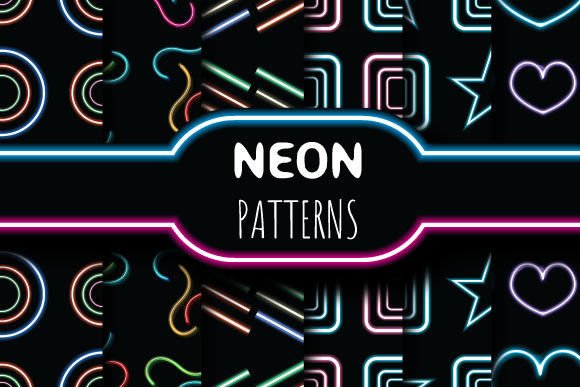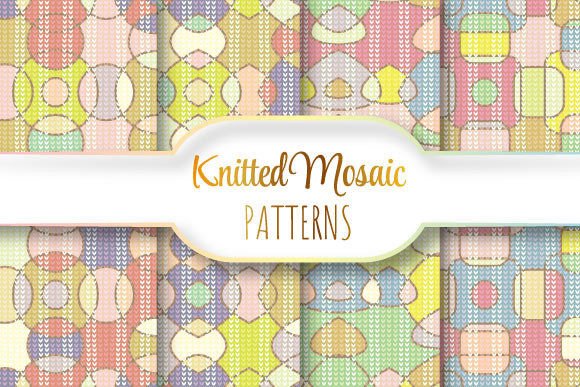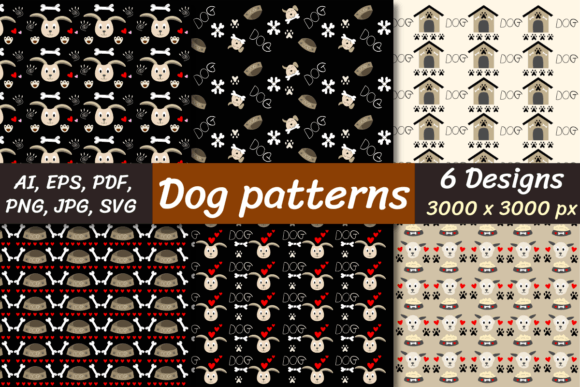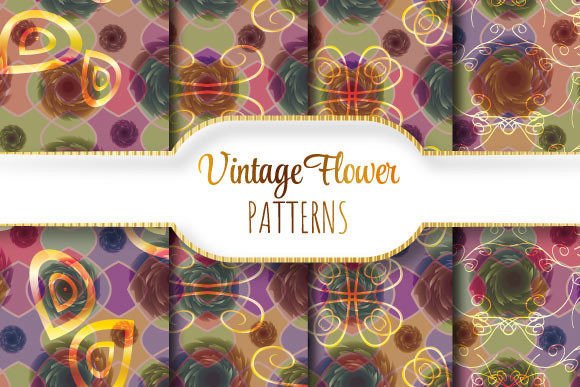
48 Seamless Geometrical Patterns
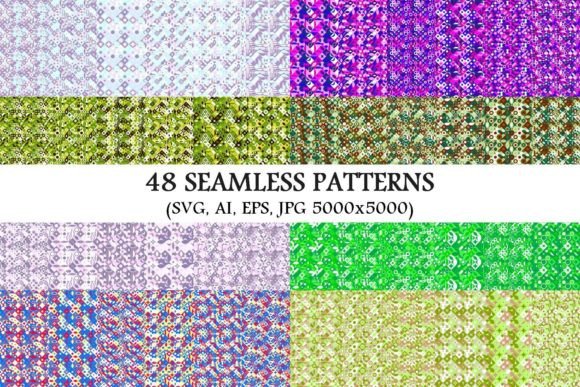
If you’ve ever spent 20 minutes searching for a clean, scalable background that doesn’t tile awkwardly—or worse, pixelates at large sizes—you already know the value of a thoughtfully built pattern library. 48 Seamless Geometrical Patterns solves that problem decisively: it’s a tightly curated, production-ready collection designed for real work, not just inspiration boards.
What Makes These Patterns Actually Usable?
This isn’t a grab-bag of abstract shapes. Every one of the 48 patterns is rigorously tested for true seamlessness—no visible joins, no alignment drift, no distortion when repeated across any canvas size. They’re built with precision vector geometry: sharp angles, consistent spacing, balanced negative space, and intentional rhythm. That means whether you’re tiling across a 3000-pixel banner or scaling up to a 10-foot trade show backdrop, the integrity holds.
The package delivers each pattern in four essential formats: SVG (ideal for web, responsive design, and lightweight embedding), AI and EPS (for full editability in Adobe Illustrator or legacy workflows), and high-res JPG (5000×5000 pixels, sRGB, ready for print or CMS uploads). No conversions. No guesswork. Just immediate compatibility across platforms—from Figma and Canva to InDesign and WordPress.
Why Designers and Marketers Reach for This Set
Geometrical patterns carry quiet authority. They suggest structure without rigidity, modernity without coldness, and clarity without oversimplification. That’s why 48 Seamless Geometrical Patterns shows up in brand guidelines, pitch decks, learning modules, and product packaging—not as decoration, but as functional visual language.
A freelance UX designer used the hexagonal grid variant to build a consistent UI overlay for a data dashboard—repeating it subtly behind interactive cards to unify hierarchy without competing with content. An educator layered a low-contrast triangular motif into her online course slides, creating visual continuity across 47 lessons while reducing cognitive load. A small-batch candle brand printed a minimalist diamond tessellation onto matte-finish labels—elevating perceived quality without increasing production cost.
Real-World Applications Beyond “Just Backgrounds”
Don’t limit these to full-bleed fills. Their versatility shines in nuanced roles:
- Layered textures: Overlay at 5–15% opacity on photos or gradients to add depth and dimension—especially effective in social ads where flat visuals fade fast.
- Print-ready elements: Use individual motifs as borders, dividers, or corner accents in brochures, business cards, or presentation handouts—no raster artifacts, even under magnification.
- Interactive states: Export SVG versions and apply CSS transforms (rotate, scale, change fill) to create subtle hover or loading animations—no extra assets needed.
- Educational scaffolding: Math and design educators use the underlying grids (isometric, triangular, modular squares) as teaching tools—visible structure helps learners grasp proportion, symmetry, and repetition concepts concretely.
Efficiency You Can Measure
Time saved isn’t theoretical here. One marketing manager reported cutting background creation time by 65% across Q3 campaigns—replacing custom Illustrator builds with drag-and-drop pattern swaps. Another noted fewer revision rounds: because all 48 patterns share consistent stroke weights, spacing logic, and color neutrality (most are grayscale or palette-friendly), stakeholders approve faster. There’s no “Is this supposed to look like that?” confusion.
And because every file is pre-optimized—SVGs stripped of redundant metadata, JPGs compressed without visible loss, AI/EPS files organized with named layers—the package integrates smoothly into existing asset management systems. No renaming, no reformatting, no version chaos.
Choosing the Right Pattern Isn’t Guesswork
Look beyond aesthetics. Ask: Does this support my message—or distract from it? A dense interlocking pattern may energize a tech startup’s landing page but overwhelm a meditation app’s onboarding flow. A bold chevron works powerfully in motion graphics but can feel aggressive in academic publishing.
Start with contrast and context. For digital interfaces, test patterns at 10% and 20% opacity first—many gain sophistication when subdued. For print, verify color mode: the JPGs are sRGB, so convert to CMYK only if your printer requires it (and always soft-proof). And remember—seamlessness isn’t just about edges. Check how the pattern behaves near text blocks or CTA buttons. Does it compete? Does it recede appropriately? The strongest uses of 48 Seamless Geometrical Patterns treat them as supporting infrastructure, not center stage.
Who Benefits Most—and How
Freelancers appreciate the cross-format reliability—it means one purchase covers client requests across web, social, and print, without upselling extras. Small business owners use the set to maintain visual consistency across Shopify banners, email headers, and Instagram story templates—no designer on retainer needed. Educators repurpose motifs into worksheets, slide templates, and classroom posters, reinforcing spatial reasoning visually. Even developers find value: the SVGs integrate cleanly into React components or CSS background-image declarations, enabling dynamic theming without bloated libraries.
One unexpected use case came from a podcast producer who mapped rhythmic patterns—like staggered dot arrays or phased line repeats—to audio waveform visuals. The geometry mirrored cadence and pacing, making episode thumbnails feel cohesive with the listening experience itself.
A Word on Longevity and Fit
Trends come and go, but well-executed geometry endures. These aren’t “2024 hot takes”—they’re rooted in principles of balance, proportion, and repetition that have held for centuries. That means your investment stays relevant through rebrands, platform migrations, and audience shifts.
Still, don’t default to “more is better.” You likely won’t need all 48 at once. Start with three that align with your current project’s tone: one structured (e.g., modular grid), one organic-leaning (e.g., softened polygons), and one minimal (e.g., spaced parallel lines). Build familiarity. Then expand as needed. The strength of 48 Seamless Geometrical Patterns lies not in quantity alone—but in the intention behind each one.