Art Deco Christmas Patterns
Christmas design doesn’t have to mean scrolling endlessly for “festive” or “vintage” — only to land on clichéd snowflakes or overly rustic textures. If you’re aiming for elegance that feels both timeless and intentional, Art Deco Christmas Patterns offer a refined alternative: geometric precision, luxurious symmetry, and warm classic charm — all built for real-world use.
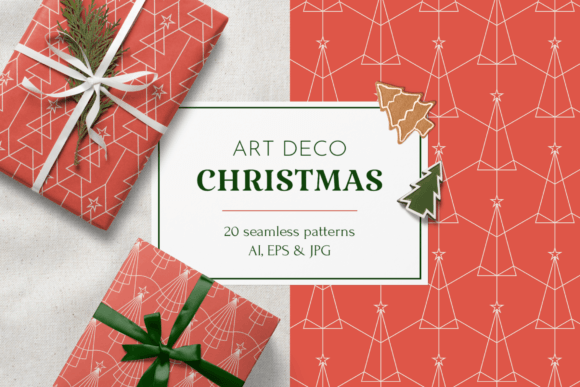
These aren’t just decorative motifs. They’re carefully crafted, tileable patterns rooted in the visual language of the 1920s and ’30s — think stepped motifs, sunbursts, stylized florals, chevrons, and streamlined foliage — reimagined with holiday spirit: subtle holly sprigs, abstracted stars, ribbon-wrapped ornaments, and gilded wreaths. The result? A cohesive aesthetic that reads as sophisticated, not nostalgic — perfect when you want celebration without sentimentality.
Why Art Deco Works for Modern Holiday Projects
Art Deco thrives in spaces where clarity and character matter. Its strong lines and balanced repetition translate exceptionally well to print and digital applications — from packaging to social media banners, greeting cards to storefront displays. Unlike trend-driven styles that age quickly, Art Deco’s structure gives it staying power. A business owner launching seasonal merchandise this December can confidently reuse these patterns next year — no redesign fatigue, no visual whiplash.
More importantly, it solves a quiet but common problem: how to stand out *without* shouting. In crowded inboxes, marketplaces, or physical retail environments, subtlety with intention often wins. An invitation printed on matte stock with a muted gold Art Deco border conveys warmth and care — more effectively than glitter overlays or loud typography ever could.
What’s Inside — And Why Format Variety Matters
The collection includes 20 tileable vector files in AI, 20 in EPS, and 20 high-res JPGs (4400 × 4400 px, 300 dpi). That’s not redundancy — it’s flexibility built into the foundation.
- AI files let designers adjust colors, scale elements, or isolate motifs directly in Adobe Illustrator — ideal for customizing a pattern to match brand guidelines or tweaking spacing for a specific layout.
- EPS files ensure compatibility across older design software and some print workflows, especially useful for freelancers collaborating with printers who require legacy formats.
- JPGs are production-ready for immediate use: upload straight to Canva, Shopify product mockups, email templates, or social media posts — no vector expertise needed.
This format coverage means you’re not choosing between “what looks nice” and “what actually works.” Whether you’re a small-batch ceramicist designing gift wrap labels, a teacher creating classroom decorations, or a marketer building a holiday campaign, you’ll find a version that fits your tools and timeline.
Real Projects, Real Time Saved
Consider a freelance graphic designer preparing three client holiday campaigns in November. One needs elegant stationery for a luxury boutique; another calls for bold packaging for a candle brand; the third is a cozy-but-polished blog series on sustainable gifting. Instead of sourcing, editing, and testing dozens of separate assets, they apply one consistent Art Deco Christmas Patterns set across all three — adjusting color palettes per brand, scaling motifs for different surfaces, and maintaining visual cohesion without reinventing the wheel.
Or take an educator planning December activities. Printing 30+ student name tags, classroom banners, and reward certificates usually means hunting for free clipart — then wrestling with low-res downloads or mismatched styles. With these patterns, a single JPG file scales cleanly to any size, and the tileable nature means seamless repeats on large-format posters or small badges alike.
Who Benefits Most — And Where It Fits Best
Professionals who value consistency and craft — like branding consultants, wedding stationers, and boutique publishers — find immediate utility here. So do creators who juggle multiple roles: a blogger who designs their own newsletter headers, prints holiday cards, and updates their Etsy shop banner all in one afternoon.
Small business owners selling physical goods benefit particularly from the print-ready resolution and vector scalability. A scarf designer can repeat a subtle zigzag-and-star pattern across fabric without pixelation; a baker can wrap cookies in custom-printed tissue paper using the same motif that appears on their Instagram story highlights.
That said, Art Deco Christmas Patterns isn’t a universal fit. If your brand voice leans heavily into maximalist, hand-drawn, or hyper-modern minimalism (think stark monochrome sans-serif + negative space), these patterns may feel tonally misaligned. Likewise, if you need photorealistic textures or highly illustrative scenes (e.g., Santa in a sleigh), this collection prioritizes abstraction and rhythm over literal storytelling.
Thoughtful Use Starts with Intention
Because these patterns are tileable and geometric, they respond well to thoughtful restraint. Try pairing a bold sunburst motif with generous white space — rather than layering multiple complex patterns together. Or use a simplified chevron variant as a subtle background behind crisp typography, letting the shape support, not compete with, your message.
Color adaptation is straightforward: most vectors are built with editable swatches, so swapping a deep emerald for navy or rose gold for antique brass takes seconds. For JPG users, basic photo-editing tools (like Photoshop Express or even Canva’s color filters) can shift tones convincingly — no need for advanced skills.
A Warm Classic Style — Without the Guesswork
“Yes, Christmas is coming. Make your holiday in a warm classic style with these Art Deco Christmas Patterns.” That line isn’t marketing fluff — it’s a practical promise. Warmth comes from balance: rich but not heavy, ornate but not cluttered, festive but never frantic. Classic comes from structure: repetition you can trust, geometry that aligns, and motifs that hold up at any scale.
And “everything for your project is covered up” reflects real preparation — not just quantity, but thoughtful coverage. Twenty distinct patterns means variety without fragmentation: enough options to avoid repetition fatigue, but curated enough to preserve visual harmony. You won’t waste hours sifting through 100 near-identical variants — just choose the right rhythm for your purpose and go.
Whether you’re sending invitations that reflect your personal taste, building a brand moment that lingers beyond December 25th, or simply reclaiming joy in the making — these patterns meet you where you are. No forced trends. No visual compromise. Just warm, classic, quietly confident holiday design — ready when you are.