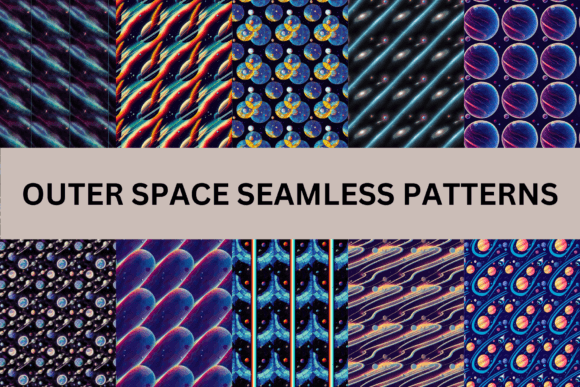
Outer Space Seamless Patterns
Outer Space Seamless Patterns are digital design assets—carefully crafted, tileable graphics inspired by the cosmos: nebulae, stars, galaxies, planetary textures, and cosmic dust. Unlike static images, these patterns repeat flawlessly edge-to-edge, so they scale infinitely across any surface without visible seams or breaks. That means no awkward gaps, no distorted edges—just smooth, professional continuity whether stretched across a 4K monitor background or printed yard after yard on fabric.
Why This Matters—Depending on Who You Are
What makes Outer Space Seamless Patterns valuable isn’t universal—it shifts with your role, goals, and daily workflow. A graphic designer might reach for them to add depth to a client’s presentation slide deck. A science educator could use one as a subtle backdrop for an astronomy lesson handout. A small-batch apparel maker may print it onto organic cotton tees. And a blogger writing about stargazing might embed it into a newsletter banner—all without needing advanced technical skills.
For Beginners and Hobbyists
If you’re just starting out with Canva, Photoshop Elements, or even PowerPoint, seamless patterns lower the barrier to polished design. You don’t need to know how to blend layers or adjust opacity curves—you simply drag, drop, and resize. Try applying a soft purple nebula pattern as a background for a personal vision board, or layer a subtle starfield over a printed journal cover. Priorities here tend to be ease of use, visual appeal, and no learning curve. Many beginners also appreciate patterns that come in multiple file formats (PNG, JPG, SVG) and include clear instructions—even if those instructions are just “open in your editor and fill the canvas.”
For Designers and Creative Professionals
Experienced designers often evaluate Outer Space Seamless Patterns through a lens of flexibility and technical reliability. They check resolution (300 DPI for print? Retina-ready for web?), tile dimensions (are they optimized for CSS background-repeat or textile repeats?), and color fidelity (does the RGB version match the CMYK preview?). A motion designer might extract a starburst element to animate it; a UI/UX specialist may use a low-contrast cosmic gradient as a subtle app interface overlay. For them, consistency across devices—and compatibility with Figma, Adobe Suite, or Procreate—is non-negotiable.
For Educators and Content Creators
In classrooms or online courses, Outer Space Seamless Patterns support engagement without distraction. A middle school teacher building a solar system unit can use a gentle galaxy pattern behind vocabulary cards—adding thematic cohesion without overwhelming young readers. Similarly, podcasters launching a space-themed show might apply a deep-space pattern to episode thumbnails or social media banners. Here, clarity, accessibility (e.g., sufficient contrast for readability), and reusability across platforms matter most. Some educators also look for patterns labeled “school-friendly” or bundled with editable text placeholders—so students can personalize projects without redesigning from scratch.
For Small Business Owners and Marketers
When branding a new product line—say, eco-friendly notebooks branded as “Cosmic Journal”—Outer Space Seamless Patterns help establish visual identity fast. You can unify packaging, website headers, email footers, and Instagram story templates using one cohesive motif. That saves time and strengthens recognition. For marketers, commercial licensing clarity is essential: Can you use the pattern on merchandise you sell? Is attribution required? Do extended licenses cover unlimited physical units? Speed matters too—being able to download, test, and deploy within an hour helps meet tight campaign deadlines.
For Fabric Artists and Makers
Hobbyist sewers, quilters, and indie textile designers rely on precise repeat logic. A true seamless pattern for fabric must align perfectly at both horizontal and vertical edges—no misaligned constellations or doubled stars when tiled across a quilt top. Those working with Spoonflower or Printful will want patterns sized for common fabric repeat dimensions (e.g., 12" × 12", 24" × 24") and provided in high-resolution TIFF or PDF format. For this group, print accuracy, color calibration support, and real-world swatch previews carry more weight than flashy animations or trendy filters.
What to Look For—Beyond the Aesthetic
Not all outer space patterns deliver equal value. Ask yourself:
- How will I use it? If it’s for web only, lightweight PNGs with transparency work well. For large-format printing, look for vector options or 300+ DPI raster files.
- Do I need customization? Some collections include layered PSD files—letting you tweak colors, adjust glow intensity, or isolate elements like planets or comet trails.
- Is licensing aligned with my intent? Free downloads often restrict commercial use. Paid packs usually clarify usage rights upfront—ideal if you're designing for clients or selling products.
- Does it support my workflow? Check whether files are organized intuitively (e.g., “Dark Nebula – Light Text Overlay Version”) and whether metadata (like keywords or color codes) is included.
Real Projects, Real Uses
A freelance illustrator used a monochrome starfield pattern to create a series of printable astronomy-themed greeting cards—scaling the same asset across six card sizes with zero rework. A homeschool parent printed a soft blue-and-gold galaxy pattern onto iron-on transfer paper and applied it to denim jackets for a themed science fair. A university communications team embedded a subtle cosmic grid into their annual report’s chapter dividers—giving the document quiet sophistication without competing with data visuals.
None of these users needed astrophysics knowledge—or even advanced software. They needed something beautiful, functional, and ready to serve their specific intention.
Does It Fit Your Next Step?
If you’re evaluating Outer Space Seamless Patterns, start by naming your next project—not the ideal one, but the real one. Is it a Canva flyer due tomorrow? A fabric order going to print next week? A classroom poster needing accessibility review? Match the pattern’s features to that concrete need—not to abstract notions of “professionalism” or “trendiness.”
You’ll know it’s right when it disappears into your work—not as a decoration, but as infrastructure: reliable, invisible, and quietly elevating everything around it.