Polka Dot Patterns Bundle
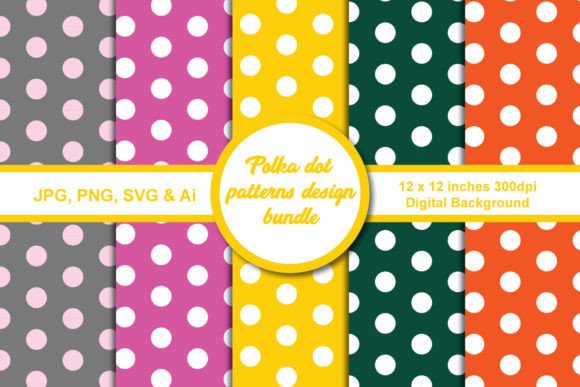
The Polka Dot Patterns Bundle is more than a collection of repeating circles—it’s a versatile, production-ready asset designed for intentionality. At its core, it delivers 12-inch square digital papers in four widely compatible formats: JPG, PNG, SVG, and Adobe Illustrator (AI). Each file renders at 300 DPI—ensuring crisp output whether printed on stationery, fabric, packaging, or large-format signage. Its flexibility isn’t accidental; it’s engineered to support real-world decisions about time, consistency, brand expression, and execution speed.
Why Strategic Selection Matters More Than Quantity
Many designers accumulate pattern libraries without clarifying how—or whether—they’ll serve specific outcomes. The Polka Dot Patterns Bundle stands apart because its utility scales with purpose, not just volume. A polka dot motif carries distinct psychological and cultural associations: playfulness, rhythm, retro charm, or even precision (think medical charts or engineering schematics). Choosing it deliberately—not decoratively—means aligning that resonance with your audience’s expectations and your project’s functional needs.
For example, an educator designing printable classroom resources might select a subtle, low-contrast polka dot as a background texture to reduce visual fatigue without sacrificing readability. A small-batch candle maker, by contrast, may use a bold, high-saturation version across labels and gift boxes to reinforce brand personality and shelf presence. In both cases, the Polka Dot Patterns Bundle serves as infrastructure—not decoration.
Practical Integration Across Workflows
Because the bundle includes JPG, PNG, SVG, and AI files, integration requires minimal technical overhead. You don’t need specialized software to begin. A JPG works instantly in Canva or Google Slides. A PNG with transparency enables layering over photos in Photoshop or Figma. An SVG scales infinitely for web banners or laser-cut templates. The AI file supports precise vector editing—ideal for adjusting spacing, color palettes, or scaling for embroidery digitizing or screen printing.
This format diversity reduces friction in cross-functional collaboration. A marketing manager can share the PNG with a freelance designer for social media assets while simultaneously sending the SVG to a print vendor for business cards—no conversion delays, no quality loss, no licensing ambiguity.
When Simplicity Accelerates Decision-Making
Overcomplicating pattern selection slows down execution—and erodes consistency. If your brand guidelines specify a primary accent pattern, having one reliable, high-fidelity option like the Polka Dot Patterns Bundle eliminates endless searching, testing, and revising. That saved time compounds: faster mockups mean quicker stakeholder feedback; faster proofs mean earlier production sign-off; faster iterations mean more room for thoughtful refinement—not rushed compromise.
Consider a wedding planner building customizable invitation suites. With the Polka Dot Patterns Bundle, they can pre-load consistent backgrounds into their design templates—ensuring every client receives cohesive stationery (save-the-dates, menus, place cards) without rebuilding from scratch each time. That operational efficiency translates directly into capacity: one planner can manage more clients without diluting quality.
Risks of Using Without Context
Patterns are powerful—but context determines impact. Applying polka dots indiscriminately risks visual noise, misaligned tone, or unintended connotations. A healthcare startup using bold red-and-white dots on patient intake forms may unintentionally evoke clinical urgency rather than approachability. A luxury skincare brand choosing tightly spaced, high-contrast dots for packaging could undermine perceptions of calm and refinement.
Before deploying the Polka Dot Patterns Bundle, ask:
- What feeling or association should this evoke for the person seeing it? (e.g., lightheartedness vs. structure)
- How does it interact with typography, photography, or product imagery? (Does it compete or complement?)
- Where will it be seen—and at what scale? (A fine dot may vanish on mobile; a large dot may overwhelm on letterhead.)
- Does it reinforce or contradict existing brand signals? (Color, spacing, weight, and rhythm all contribute to recognition.)
Without answering these, even a technically perfect file becomes a liability—not an asset.
Long-Term Value Through Intentional Reuse
Digital assets depreciate when treated as disposable. The Polka Dot Patterns Bundle gains value the more thoughtfully it’s reused across touchpoints and timelines. A nonprofit using it for annual report backgrounds, donor thank-you cards, and event banners builds subconscious familiarity. Over three years, that repetition strengthens visual memory—without requiring new design fees or approval cycles.
Similarly, educators can embed the same polka dot grid as a subtle writing prompt background in digital worksheets, then print matching flashcards or classroom posters. Students begin recognizing the pattern as part of the learning environment—not as random decoration. That consistency supports cognitive load management and reinforces institutional identity.
Planning Tips for Sustainable Use
Start small—but plan broadly. Try the Polka Dot Patterns Bundle in one controlled setting first: a single email newsletter template, a set of internal presentation slides, or a batch of handmade greeting cards. Observe how it performs—does it improve scannability? Does it feel aligned with your voice? Does it simplify production?
Then document your findings. Note which format worked best (e.g., “PNG with 20% opacity worked for layered text overlays”), which color adjustments enhanced clarity (“desaturating the blue dot improved legibility on light beige paper”), and where spacing needed adjustment (“reduced repeat scale by 15% for fabric printing”). This isn’t busywork—it’s building institutional knowledge that informs future purchases and usage.
Also consider accessibility. While polka dots themselves aren’t inherently inaccessible, contrast ratios between dot and background must meet WCAG 2.1 standards for text overlays. Test combinations early—not after finalizing a full suite of materials.
Positioning Beyond Aesthetics
In competitive markets, differentiation often lives in execution details—not just messaging. A boutique stationer using the Polka Dot Patterns Bundle to create custom wrapping paper for local retailers signals reliability and attention to craft. A SaaS company incorporating a modified dot pattern into its dashboard UI communicates cohesion and intentionality—even if users never name the motif.
That positioning isn’t about trend-chasing. It’s about leveraging a proven, adaptable visual element to reduce cognitive distance between idea and experience. When customers see the same thoughtful rhythm across your Instagram story, your product label, and your invoice footer, they register continuity—not coincidence.
Final Consideration: Ownership and Control
Unlike subscription-based pattern services, the Polka Dot Patterns Bundle grants perpetual, royalty-free usage rights. You’re not renting access—you’re acquiring infrastructure. That means no renewal deadlines, no usage caps, no surprise policy changes. For freelancers quoting fixed-price projects or small businesses budgeting for seasonal campaigns, that certainty matters. It allows long-term planning without dependency on third-party platforms or licensing audits.
But ownership also brings responsibility. Storing files securely, organizing them with clear naming conventions (e.g., “PolkaDot_Bundle_Coral_300dpi_PNG”), and maintaining backups ensures the asset remains usable years later—even as software evolves. Treat it like any other operational tool: valuable only when accessible, organized, and understood.
Ultimately, the Polka Dot Patterns Bundle earns its place in your toolkit not because it’s trendy or abundant—but because it supports clarity, consistency, and control. Used with purpose, it helps you spend less time solving avoidable problems and more time delivering outcomes that matter.