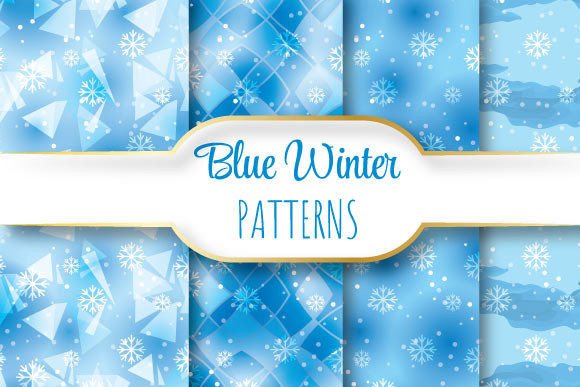
Blue Winter Patterns: Seamless Vector Designs for Precision Print and Digital Applications
Blue Winter Patterns represent a distinct category of high-fidelity, repeatable vector artwork designed for professional-grade output—where color temperature, spatial rhythm, and technical precision converge. Unlike generic snowflake motifs or abstract frost illustrations, these patterns are engineered for functional versatility: each is built as a mathematically balanced, tileable composition that maintains visual integrity across any scale, surface, or medium. At their core lies a deliberate interplay of cool-toned blues—ranging from glacial cerulean to deep midnight indigo—paired with structural elements inspired by crystalline growth, wind-sculpted snowdrifts, and the subtle geometry of ice lattice formations. But what truly sets them apart isn’t just aesthetic cohesion—it’s the rigorous technical specification that enables reliable deployment in real-world production environments.
Technical Foundations: Why 12×12 Inches, 300 DPI, and EPS 10 Matter
The standardized dimensions—12 inches by 12 inches at 3600 × 3600 pixels and 300 dots per inch—are not arbitrary. They reflect a convergence of print industry conventions and digital workflow pragmatism. A 12×12-inch canvas provides ample working space for designers to inspect fine detail without zoom fatigue, while the 300dpi resolution ensures crisp edge definition even when printed at full size on premium substrates like fine art paper, vinyl banners, or textile transfers. This density prevents pixelation or aliasing during enlargement—a common pitfall with lower-resolution repeats used in large-format applications.
The choice of EPS 10 format further underscores intentionality. Encapsulated PostScript remains the gold standard for vector scalability in commercial printing environments. Unlike raster-only formats, EPS preserves path-based geometry, allowing infinite resizing without loss of fidelity. Version 10 (introduced with Adobe Illustrator CS2) supports transparency, gradient meshes, and advanced blending modes—critical for rendering layered frost effects, soft-edged snow gradients, or translucent icicle overlays with photorealistic nuance. Importantly, EPS 10 files retain editability in current design software, enabling users to adjust colors, isolate elements, or modify anchor points without degrading the underlying structure.
Seamlessly Repeating Vector Patterns: Beyond Visual Continuity
“Seamless” in this context goes beyond invisible tiling. It denotes algorithmic consistency: every pattern aligns perfectly along both horizontal and vertical axes, with no visible seams, shifts, or tonal discrepancies at tile boundaries. This is achieved through precise anchor point placement, symmetrical path construction, and intentional negative space distribution—techniques rooted in computational geometry and textile design principles. For example, one Blue Winter Pattern may use rotational symmetry around a central hexadecagon to mimic snowflake radial growth, while another employs translational repetition with staggered vertical offsets to evoke wind-driven snow accumulation.
This seamlessness translates directly into practical advantages. In packaging design, it allows for consistent background coverage across irregular die-cut shapes—think gift boxes with curved flaps or cylindrical containers where wraparound continuity affects perceived quality. In architectural visualization, seamless repeats enable realistic wallcoverings or floor treatments in rendered scenes without texture stretching artifacts. And for educators illustrating molecular structures or crystallography, the mathematical rigor of these patterns serves as accurate visual analogs—not decorative approximations.
Real-World Deployment Across Industries
- Textile & Surface Design: Fashion studios use Blue Winter Patterns as base layers for winter collections—scaling them to match fabric repeat lengths (e.g., 24-inch or 36-inch repeats) via simple proportional transforms in Illustrator. The EPS foundation ensures clean cutting paths for digital textile printers, while JPEG variants allow quick mockups on garment templates.
- Marketing & Brand Identity: Agencies integrate these patterns into seasonal campaigns—layering them beneath transparent typography for holiday email headers, or using them as animated backgrounds in social media ads. The inclusion of four JPEG files (RGB at sRGB, Adobe RGB, CMYK, and grayscale) streamlines cross-platform adaptation without color-shift surprises.
- Education & Scientific Communication: Physics instructors project high-res JPEGs during lectures on thermodynamics or phase transitions, leveraging the patterns’ inherent symmetry to explain concepts like entropy reduction in crystalline formation. Researchers studying perceptual grouping cite the consistent spacing and contrast ratios in Blue Winter Patterns as ideal stimuli for controlled visual cognition experiments.
- Interior & Environmental Graphics: Design firms apply these vectors to wall murals in hospitality spaces—scaling a single 12×12-inch tile to cover a 10-foot-high feature wall using UV-curable inkjet printers. Because the EPS retains vector integrity, no interpolation blur occurs, preserving delicate linework in simulated frost etchings.
Workflow Integration: How Designers Actually Use the Assets
A typical implementation begins not with aesthetics—but with constraints. A packaging designer receives a brief for luxury ski resort merchandise: matte-finish rigid boxes requiring foil-stamped accents over a textured blue background. She opens the EPS file in Illustrator, ungroups the pattern layer, and adjusts the global swatch for “Arctic Blue” to match the client’s Pantone spec. Using the Appearance panel, she adds a subtle 0.5pt stroke set to “multiply” blend mode to enhance depth—knowing the vector paths will remain editable post-export.
For web use, she exports one JPEG variant at 1920×1080 pixels (72dpi) for hero banners, applying CSS background-size: 200%; to create slow parallax movement on scroll. Meanwhile, the same EPS feeds into a print-ready PDF/X-4 file, where overprint settings ensure rich blacks remain crisp alongside the cool blue tones. The ZIP package’s structure—single EPS plus four purpose-built JPEGs—eliminates guesswork: no need to convert color profiles manually or resample for differing output intents.
Considerations for Optimal Results
While Blue Winter Patterns offer broad compatibility, certain decisions impact final outcomes. First, scaling behavior differs between vector and raster contexts: enlarging the EPS introduces no degradation, but upscaling JPEGs beyond native resolution creates softness—so designers reserve JPEGs for screen or small-format print only. Second, color management requires attention: the included CMYK JPEG assumes FOGRA39 standards; users working with SWOP or GRACoL workflows should reconvert using calibrated profiles rather than relying on automatic conversions.
Third, layer organization matters. Though flattened for universal compatibility, the EPS files maintain logical grouping—“Base Crystals,” “Midground Drift,” “Foreground Icicles”—enabling selective visibility toggling. This supports iterative refinement: a branding team might disable the foreground layer to test legibility of white text against the midground alone. Finally, licensing permits commercial use but prohibits redistribution of the raw assets as standalone pattern libraries—ensuring creators retain attribution and control over derivative works.
Evolving Applications: From Static Backgrounds to Generative Systems
Emerging uses reveal how Blue Winter Patterns function as foundational components rather than static endpoints. Some motion designers import the EPS into After Effects via Adobe Dynamic Link, applying displacement maps to simulate shifting snow accumulation over time. Others feed the vector paths into generative code (using p5.js or Processing), treating anchor points as data nodes to drive parametric animations—where wind speed alters tile offset velocity, or temperature gradients modulate blue saturation in real time.
In AR experiences, developers extract SVG paths from the EPS (via Illustrator’s “Export As > SVG” function) to render lightweight, scalable winter textures on virtual storefronts or museum installations. The mathematical predictability of the patterns ensures stable occlusion handling when overlaid on physical surfaces via mobile devices. Even in AI-assisted design, these vectors serve as high-quality training anchors—helping diffusion models distinguish authentic crystalline structure from synthetic noise when generating winter-themed assets.
Why These Specifications Endure Beyond Trend Cycles
Trends in seasonal design often prioritize novelty over longevity—yet Blue Winter Patterns persist because they solve enduring problems: achieving tonal harmony without visual fatigue, enabling scalability without compromise, and supporting multi-intent workflows without redundant asset creation. Their 12×12-inch/300dpi/EPS 10 foundation reflects decades of prepress evolution—not fleeting software features. When a university lab prints a 48-inch-wide poster explaining atmospheric nucleation, or a boutique scales the same pattern to a 2-inch-diameter button badge, the underlying geometry remains unchanged. That consistency builds trust—not just in the asset, but in the process.
Ultimately, Blue Winter Patterns exemplify how disciplined technical execution amplifies creative potential. They don’t replace design judgment—they extend it. Whether adjusting hue for accessibility compliance, adapting tile frequency for tactile embossing, or repurposing line weight for laser-cut stencils, the precision embedded in each file invites intentionality. And in an era where digital clutter competes for attention, clarity—both visual and technical—remains the most quietly powerful differentiator.