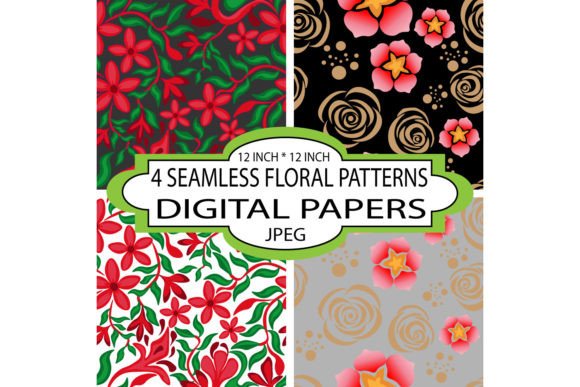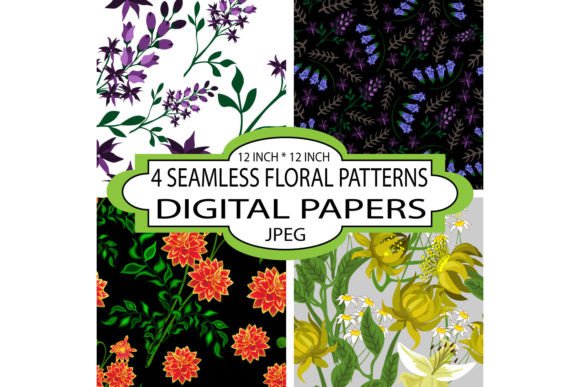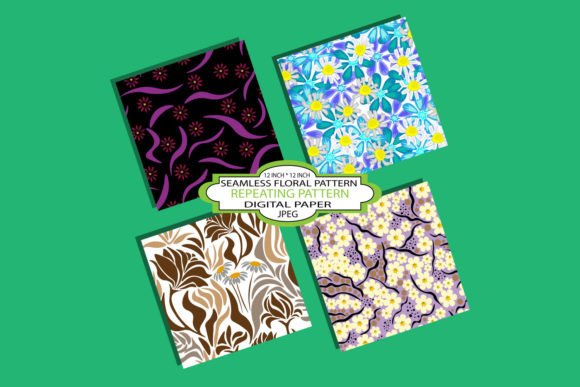
Sunflowers, Seamless Floral Patterns
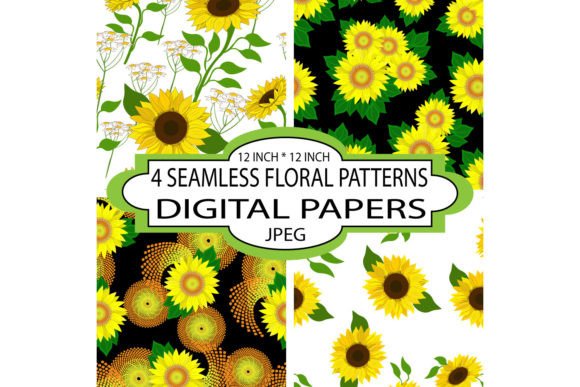
Imagine laying down a sunflower pattern that flows endlessly—no visible seams, no awkward breaks—just golden petals and lush green stems stretching across fabric, paper, or wall with quiet confidence. That’s what Sunflowers, Seamless Floral Patterns delivers: four high-resolution JPEG files (3600px × 3600px, 12″ × 12″), each built for true repeat integrity. No stripes, no misaligned edges, no visual hiccups when tiled. Just clean, retro-infused elegance—warm but refined, nostalgic but never dated.
Why Seamless Really Matters—Beyond the Buzzword
“Seamless” isn’t just a design term—it’s a functional requirement. When you’re printing custom gift wrap, designing quilt blocks, or wallpapering a feature wall, a flawed repeat creates distractions: a faint line where tiles meet, a petal that cuts off mid-stem, or rhythm that stutters instead of soothes. These patterns eliminate that risk. Each tile aligns precisely at all four edges, so whether you scale to cover a 10-foot sofa or shrink to a 2″ label, the continuity holds. That reliability saves time in prepress checks, reduces print waste, and avoids last-minute redesigns—especially valuable if you’re producing physical goods on tight deadlines or limited budgets.
Retro Elegance, Not Retro Cliché
This collection leans into mid-century botanical illustration—think soft watercolor textures, gentle contrast, and balanced negative space—but avoids kitsch. The sunflowers aren’t cartoonish or overly saturated; they carry subtle grain, delicate veining in the leaves, and restrained shading that gives depth without heaviness. That balance makes them versatile: pair them with serif typography for vintage stationery, layer them under minimalist text for modern greeting cards, or use them as understated background texture in digital presentations. Educators crafting classroom posters, bloggers designing Pinterest pins, or small-batch stationers launching a new line all find this tone adaptable—not prescriptive.
Practical Uses You Can Start With Today
- Textiles & Home Goods: Print directly onto cotton-linen blends for pillowcases or duvet covers—the 3600px resolution ensures crisp detail even at full bedsheet scale. Because the repeat is mathematically precise, you won’t need to manually adjust tile placement in your fabric software.
- Card Making & Stationery: Scale down to 4″ × 6″ for flat cards or 5″ × 7″ folded invitations. The retro warmth pairs beautifully with foil-stamped names or handwritten calligraphy—no competing visual noise.
- Scrapbooking & Digital Layouts: Import as layered PNGs (via simple background removal) or use as-is for full-page backgrounds. The consistent 300 DPI output means printed layouts retain clarity—even when scanned or shared digitally.
- Interior Design Mockups: Interior designers and real estate stylists use these patterns in mood boards or client presentations. Drop one into a 3D room render at 50% opacity to suggest wallpaper, or apply it to a virtual pillow model to show cohesion across a bedroom scheme.
Who Benefits Most—and Why Timing Matters
Freelance surface pattern designers often spend weeks perfecting seamless repeats—testing tiling logic, adjusting color balance across edge transitions, and exporting multiple formats. Having four production-ready sunflower options means skipping that phase entirely and focusing instead on customization: recoloring for a client’s brand palette, combining with geometric overlays, or adapting motifs for embroidery digitizing. Small business owners launching seasonal collections (e.g., summer garden-themed gift boxes or back-to-school planners) gain agility—these files integrate quickly into Canva, Adobe Illustrator, or Cricut Design Space without needing advanced raster editing skills.
Hobbyists and educators also benefit from predictability. A homeschool parent creating nature-themed learning journals doesn’t need to troubleshoot alignment—they can print, cut, and bind knowing the floral flow stays intact across every page. Similarly, art teachers guiding students through pattern design can use these as teaching references: “Notice how the stem curves *into* the top edge while echoing the bottom—this is intentional repeat architecture.”
A Note on Fit and Realistic Expectations
These are JPEGs—not vector files—so they’re ideal for raster-based workflows (print-on-demand, photo editing, web graphics) but less suited for infinite scalability like logos or signage requiring extreme enlargement. If you need crisp lines at billboard size or editable paths for laser cutting, pairing these with a vector companion set would be wise. Also, while the color profile is sRGB-optimized for screen accuracy and standard CMYK print, professional textile printers may request a separate ICC profile adjustment depending on substrate (e.g., silk vs. canvas). Always soft-proof before final production runs.
How to Maximize Value Without Overcomplicating
Start small. Try one pattern as a full-page background in a printable planner sheet—see how the sunflowers frame weekly goals without overwhelming text. Then test a second at 20% opacity behind a quote graphic for social media. Notice how the retro elegance adds warmth without demanding attention. Once you’ve confirmed the tone fits your voice or brand, scale up: apply the same file across matching notecards, envelope liners, and sticker sheets. Consistency builds recognition; seamlessness builds trust.
For marketers building email campaigns around seasonal launches, these patterns offer subtle thematic anchoring. A sunflower motif in a spring newsletter footer—repeated cleanly across devices—reinforces messaging about growth, optimism, or natural simplicity without needing explicit copy. That kind of quiet cohesion strengthens communication more than bold fonts ever could.
Final Thought: Design That Serves, Not Distracts
Good pattern design doesn’t shout. It supports. It settles in. It lets content breathe while adding quiet character. Sunflowers, Seamless Floral Patterns does exactly that—offering warmth rooted in botanical authenticity, precision built for real-world application, and elegance that feels earned, not applied. Whether you’re hand-lettering wedding envelopes, prototyping a capsule clothing line, or designing a calming therapy office brochure, these files remove friction so your intention—not technical limits—guides the outcome.