Valentine Red Cupid Love Patterns: A Practical Guide for Designers and Creators
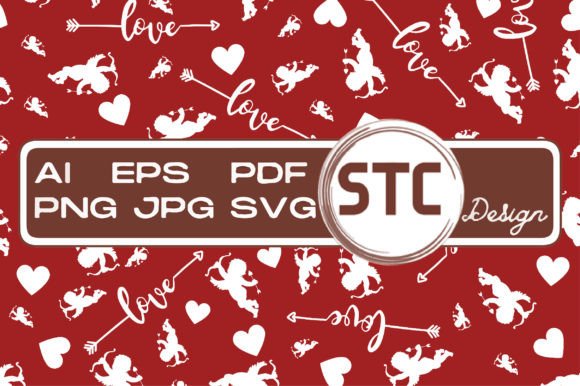
Valentine Red Cupid Love Patterns is a curated digital asset pack built around a cohesive, modern vector illustration style—featuring stylized Cupids, hearts, arrows, and romantic motifs rendered in rich red tones against clean, seamless backgrounds. Unlike generic clipart or low-resolution scrapbook elements, this collection is engineered for professional application across both digital and print workflows. Its defining traits include technical precision (300 dpi resolution, 12×12 inch dimensions), format versatility (AI, EPS, SVG, PDF, PNG, JPEG), and intentional design logic—making it especially useful for creators who need consistency, scalability, and production readiness.
What Sets Valentine Red Cupid Love Patterns Apart
The distinction lies not just in aesthetics but in execution. Each pattern is truly seamless—tested across tile repeats without visible breaks or alignment shifts—so it performs reliably on fabric, wallpaper, or web backgrounds. The red palette isn’t oversaturated or screen-dependent; it’s calibrated with CMYK JPEGs included specifically for accurate printing, while RGB PNGs preserve vibrancy for websites, apps, or social media. The vector files (AI, EPS, SVG) retain full editability: colors can be adjusted, elements ungrouped, and compositions reconfigured without quality loss. That level of flexibility is rare in themed pattern packs, where many offerings prioritize decorative appeal over technical utility.
Also notable is the uniformity of scale and spacing. Unlike hand-drawn or scanned patterns that vary in density or rhythm, these are mathematically balanced—ideal for products like planners, notebook covers, or tablecloths where visual weight and repetition matter. The “modern vector illustration” style avoids cliché: no photorealistic Cupids or ornate Baroque flourishes. Instead, clean linework, subtle gradients, and balanced negative space give the patterns longevity beyond seasonal use.
How It Compares Across Common Use Cases
For website and blog backgrounds, Valentine Red Cupid Love Patterns offers an advantage over stock photo-based overlays: vector-derived SVG or high-res PNG files load faster and scale crisply on retina displays. Compared to CSS-generated heart patterns or basic SVG icons, this pack delivers richer thematic cohesion—every element shares proportion, stroke weight, and color harmony. That consistency supports brand tone without requiring custom illustration work.
In print-on-demand and shop design, the inclusion of CMYK JPEGs matters. Many free or budget pattern resources supply only RGB files, leading to unexpected dullness or hue shifts when printed on mugs, tote bags, or greeting cards. With Valentine Red Cupid Love Patterns, designers can proof accurately before production—reducing reprints and color correction delays. The 3600×3600 pixel resolution also accommodates large-format prints like posters or wall murals without upscaling artifacts.
For textile and fabric applications—including batik, ethnic apparel, or table linens—the seamless tiling behavior is essential. Some alternative pattern libraries offer “seamless” labels but fail under real-world repeat testing. This pack has been verified across multiple tile configurations, making it safer for fabric printers using roll-fed or digital textile systems. Its moderate motif density (neither overly sparse nor visually overwhelming) also translates well across varied garment cuts and home décor scales.
Strengths and Real-World Tradeoffs
Strengths:
- Format coverage bridges digital and physical production needs.
- Seamless tiling works across surfaces—from mug wraps to carpet repeats—without manual editing.
- Red-centric palette is versatile: pairs easily with neutrals (cream, charcoal, ivory) or complements metallic accents (gold foil, rose gold foil).
- Vector source files allow adaptation—for example, extracting a single Cupid icon for a logo or resizing a heart motif for embroidery digitizing.
Tradeoffs to consider:
- Limited color variation: while red dominates, there are no alternate palettes (e.g., blush, navy, or monochrome versions) included. Users needing broader chromatic options will need to recolor manually—or seek supplemental assets.
- No animation-ready formats: if you’re building interactive web elements or social media stories, GIF or Lottie exports aren’t part of the package.
- Thematic focus is specific: while “Valentine” implies seasonal use, the modern styling allows year-round reinterpretation—but it won’t suit minimalist, industrial, or nature-focused brands without careful contextual framing.
When It Fits—and When It Might Not
Valentine Red Cupid Love Patterns fits best when your project requires cohesive, production-ready romantic visuals without custom illustration overhead. Think: launching a limited-edition planner line for February, designing a boutique wedding stationery suite, updating an e-commerce store’s seasonal homepage, or producing fabric for a small-batch apparel launch. Its value increases with volume—if you’re applying the same pattern across ten product SKUs, the time saved in sourcing, testing, and adapting pays off quickly.
It may be less suitable if your work demands strict historical accuracy (e.g., Renaissance Cupid iconography), maximalist texture layers (like watercolor bleed or distressed edges), or multi-layered editable PSD files for complex compositing. Similarly, if your brand voice leans heavily into irony, satire, or gender-neutral abstraction, the warmth and directness of the red Cupid theme could feel tonally misaligned—even with recoloring.
Also worth noting: while the pack includes 10.2 MB of files, it’s not a “library” of hundreds of variations. It’s a focused set—designed for clarity and reuse, not exhaustiveness. That’s a benefit for decision fatigue but a limitation if you expect dozens of alternate motifs or layout templates.
Practical Integration Tips
For web developers: SVG files embed directly into HTML or CSS background declarations. Use the background-size property to control tile scale—especially helpful for responsive hero sections where pattern density must adjust across devices.
For print designers: open the EPS or PDF in Adobe Illustrator to isolate individual motifs. Convert strokes to outlines before sending to a printer, and double-check that CMYK JPEGs match your printer’s ICC profile—particularly for coated vs. uncoated paper stocks.
For fashion and textile designers: test the pattern at actual fabric scale first. A 12×12 inch tile may look balanced on screen but read too busy on a lightweight cotton voile. Adjust repeat size in your design software before finalizing yardage estimates.
For planner and journal creators: layer the PNG over textured paper scans (e.g., linen or kraft) using multiply or overlay blending modes in Photoshop. This adds tactility without compromising motif clarity—ideal for premium stationery lines.
Making a Confident Choice
Valentine Red Cupid Love Patterns occupies a practical middle ground: more refined than free pattern repositories, more adaptable than rigid clipart bundles, and more production-aware than one-off illustrations. It doesn’t replace custom design—but it significantly lowers the barrier to delivering polished, on-brand romantic visuals across diverse outputs. Whether you’re evaluating it against other vector pattern sets, weighing DIY illustration against licensed assets, or deciding how much design bandwidth to allocate to seasonal updates, its consistency, format integrity, and seamless behavior provide measurable efficiency gains.
As with any digital asset, the right fit depends on your workflow, output requirements, and aesthetic goals—not just the theme. If red-toned, Cupid-infused romance aligns with your current project’s purpose, audience, and medium, and you value technical reliability alongside visual appeal, Valentine Red Cupid Love Patterns offers a grounded, reusable foundation—not just decoration.